No. An error may point to a problem in the organisation, a gap in public information or a limit of the system. Only comparison with documents and independent sources makes it possible to tell which. Even a correct answer does not prove that the company communicates well.
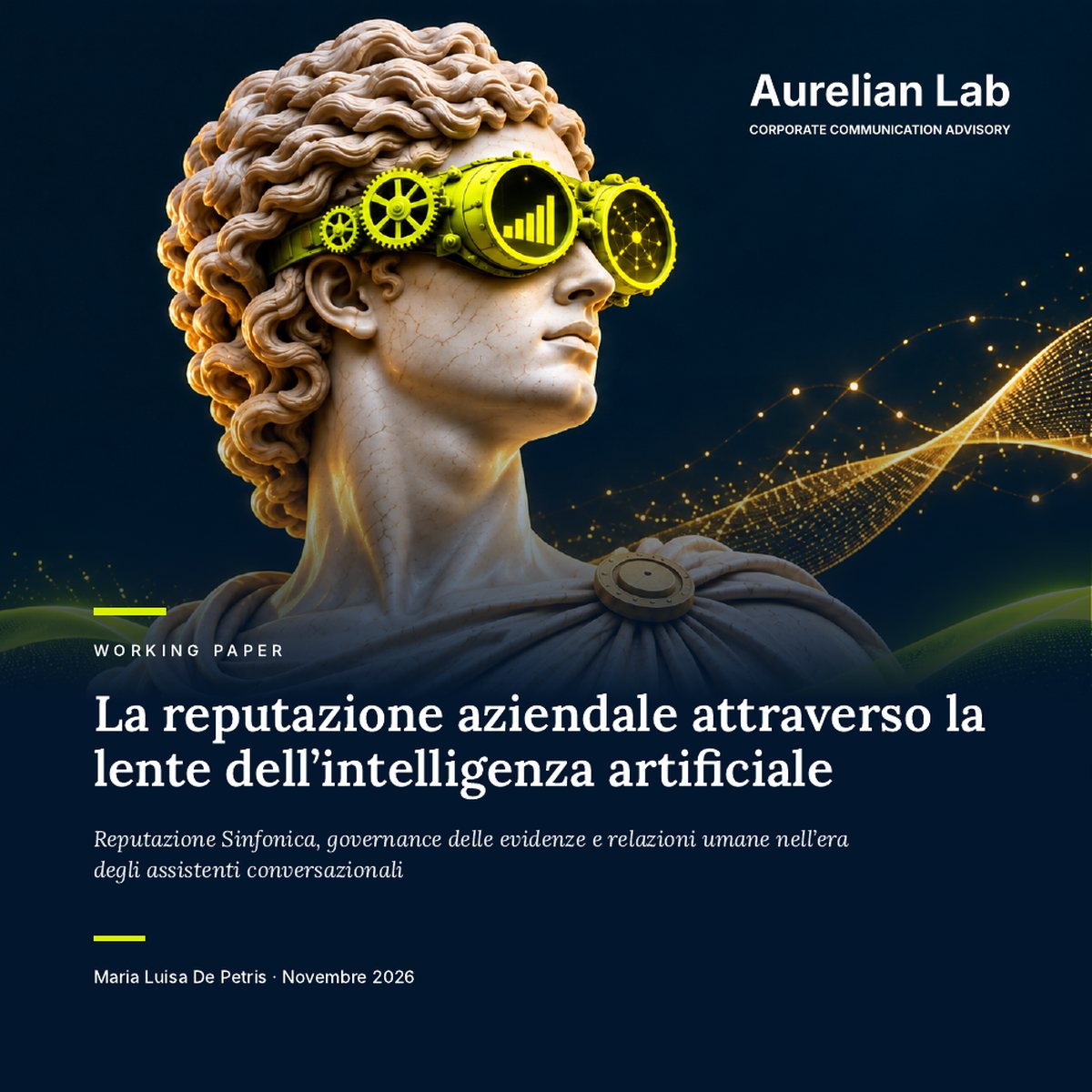
Working paper · November 2026
Corporate Reputation Through the Lens of Artificial Intelligence
Symphonic Reputation, evidence governance and human relationships in the age of conversational assistants
- Maria Luisa De Petris
- Aurelian Lab
- IT
- EN
- CC BY 4.0 licence
- DOI 10.5281/zenodo.23894619 (EN)
Abstract
The working paper examines two functions of artificial intelligence: as a diagnostic lens, which brings to light informational discrepancies that need to be checked, and as an intermediary, which selects, summarises and sometimes recommends companies. Drawing on the literature on organisational reputation, AI-mediated communication and brand experience, it proposes Symphonic Reputation as a strategic vision of Corporate Communication.
ConclusionsThe problem is solved neither by technical optimisation alone nor by multiplying content. AI is a lens for spotting possible dissonances and an intermediary to be observed, not the final judge of reputation. Symphonic Reputation becomes operational when leadership makes it a shared responsibility, articulated in five responsibilities for CEOs and Communication Directors. Evidence must support the message, governance must support the evidence, and the human relationship must keep a central role.

The starting point
A communications director asks a conversational assistant to describe their company. The answer is orderly, fluent, almost convincing. But a date is wrong, a product no longer exists, a certification was never obtained. What is it legitimate to conclude?

What Symphonic Reputation is
An organisation is represented by many voices. Some are controlled by the company (internal functions, people, corporate channels), others arise from the experience of customers, employees, media, institutions and communities. As in a musical score, the meaning of the whole can depend precisely on the differences between the parts.
Symphonic Reputation is the perspective through which Aurelian Lab aligns three dimensions: what the company does, what it communicates and how it is perceived, including by artificial intelligence models. Consistency does not mean uniformity: it means substantial compatibility between statements and behaviour, with clear responsibilities for updating and verifying information.
It is not a new psychometric definition of reputation and it does not promise to steer what every stakeholder thinks. The conductor does not control external voices: they create conditions of responsibility, listening and verifiable consistency.

What the paper argues
- An AI answer can suggest that something does not add up, without indicating the cause. The paper distinguishes three levels of dissonance (organisational, communicative, algorithmic) to be checked separately.
- Visibility, representation and reputation are distinct levels. They are measured with different tools.
- An assistant does not listen to the whole orchestra: it listens to the voices it can find and read. Governing Symphonic Reputation requires evidence, independent voices and human relationships, not just optimised content.
- AEO and GEO are opportunities, not shortcuts: the problem is solved neither by technical optimisation alone nor by multiplying content.
Three levels, not to be confused
Level 1 · Visibility
Whether the organisation appears in the answer.
Level 2 · Representation
What is said about it, and with what evidence.
Level 3 · Reputation
What stakeholders conclude over time.
Observable in a model's answer
Detected among stakeholders
Definitions in the Aurelian Watch glossary.

Five responsibilities for CEOs and Communication Directors
- 1Align statements and behaviour.
- 2Curate your own sources.
- 3Listen to, and nurture, independent voices.
- 4Observe methodically how AI describes the company.
- 5Invest in direct encounter.
Download and cite
- Working paper in Italian (PDF), on request: write to marialuisa@aurelianlab.com
- English version, open access on Zenodo ↗CC BY 4.0 · DOI 10.5281/zenodo.23894619
How to cite · Italian
De Petris, M. L. (2026). La reputazione aziendale attraverso la lente dell'intelligenza artificiale. Reputazione Sinfonica, governance delle evidenze e relazioni umane nell'era degli assistenti conversazionali. Working paper, Aurelian Lab, novembre 2026. Versione inglese: https://doi.org/10.5281/zenodo.23894619
How to cite · English
De Petris, M. L. (2026). Corporate Reputation Through the Lens of Artificial Intelligence. Zenodo. https://doi.org/10.5281/zenodo.23894619
The author
Maria Luisa De Petris is the founder of Aurelian Lab. Advanced Generative AI Practitioner, certified by AIPIA. Head of the Sustainability Leaders Mentoring Programme for the Cambridge Institute for Sustainability Leadership Alumni. ORCID 0009-0004-1414-6913.
FAQ
All FAQs →Frequently asked questions
No. Visibility is the company's presence in the answer, representation is what is said, reputation concerns stakeholders' judgements over time. Distinct measurement tools are needed.