Method and ServicesProjectsInsightsAurelian WatchObservatory newsAurelian IntelligenceAboutContact
MEASUREMENT / AI INTELLIGENCE

Aurelian Intelligence.

Aurelian Intelligence is how Aurelian Lab measures what AI systems say about your company: three proprietary tools, used within every engagement, that turn model answers into evidence and priorities.

The method

The AI lens is today the best partner of corporate communication.

It shows what is wrong and where to act. That is why each of our services starts from an analysis with the three proprietary Aurelian Intelligence tools: it is the snapshot from which the method builds, measures and corrects the company's reputation.

Each topic has its own question. The same questions, asked with the same prompts, are repeated over time, so you can see what really changes after each action.

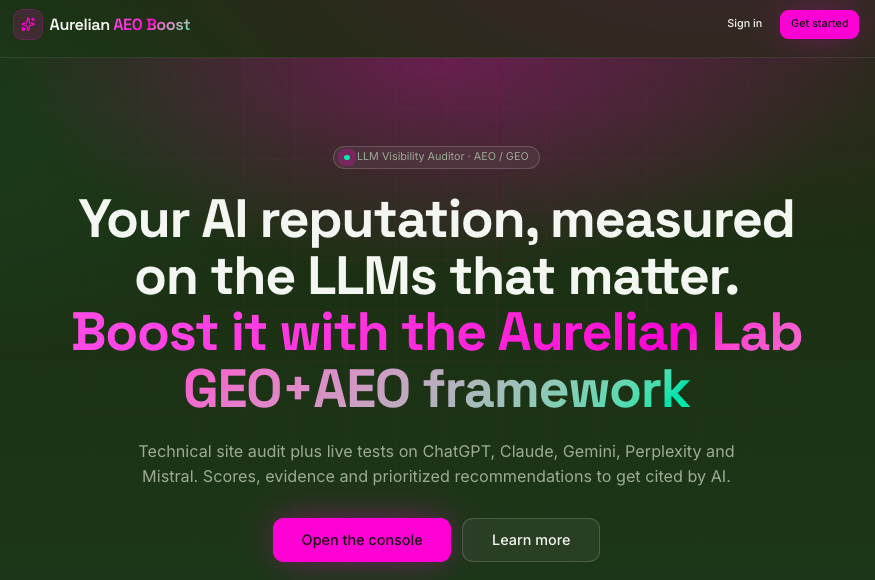
Aurelian AEO Boost — audit AEO e GEO del sito
Aurelian AEO Boost

Do AI systems find your website and cite it?

Checks how the website presents itself to answer engines: AI crawler access, llms.txt, schema and content structure. It then queries ChatGPT, Claude, Gemini, Perplexity and Mistral live with fixed prompts, so results can be compared over time.

You receive: Verifiable evidence, scores and prioritised actions.

They are used to analyse the situation and to restructure your website for AI.

Open the tool
Aurelian StakeGraph — mappa interattiva di entità e stakeholder
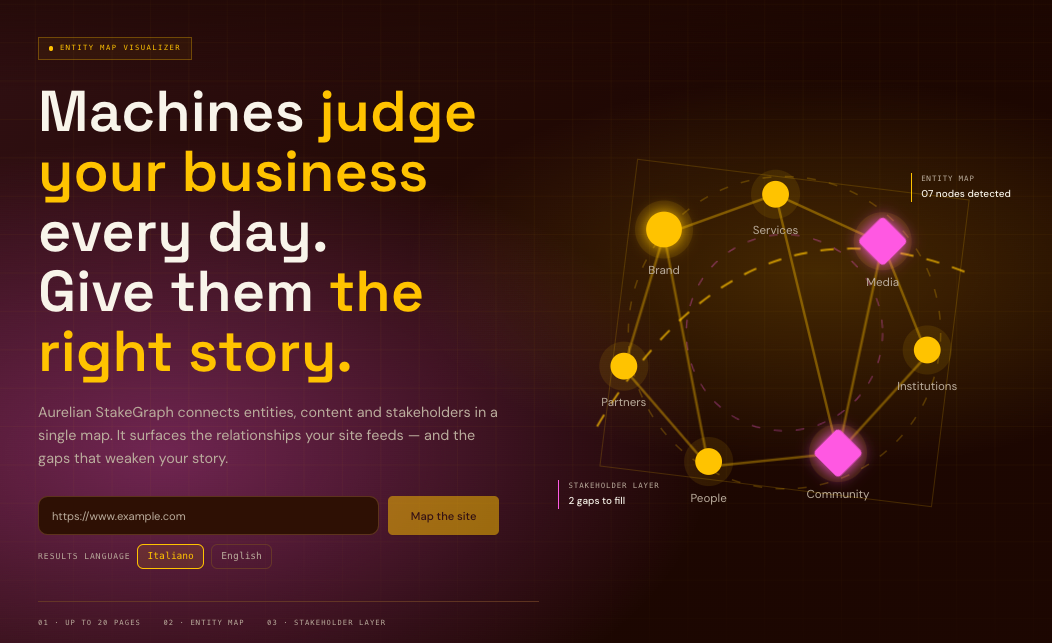
Aurelian StakeGraph

Does your website speak to the right people?

Turns the website structure into a map of pages, topics and links and cross-references it with the organisation’s stakeholder map, to see whether the content answers the people who matter most.

You receive: Under-represented stakeholders, missing content and relationships to strengthen.

They are used to analyse the situation and to restructure your website for AI.

Open the tool
Aurelian ESG Monitor — piattaforma di AI Sustainability Reputation
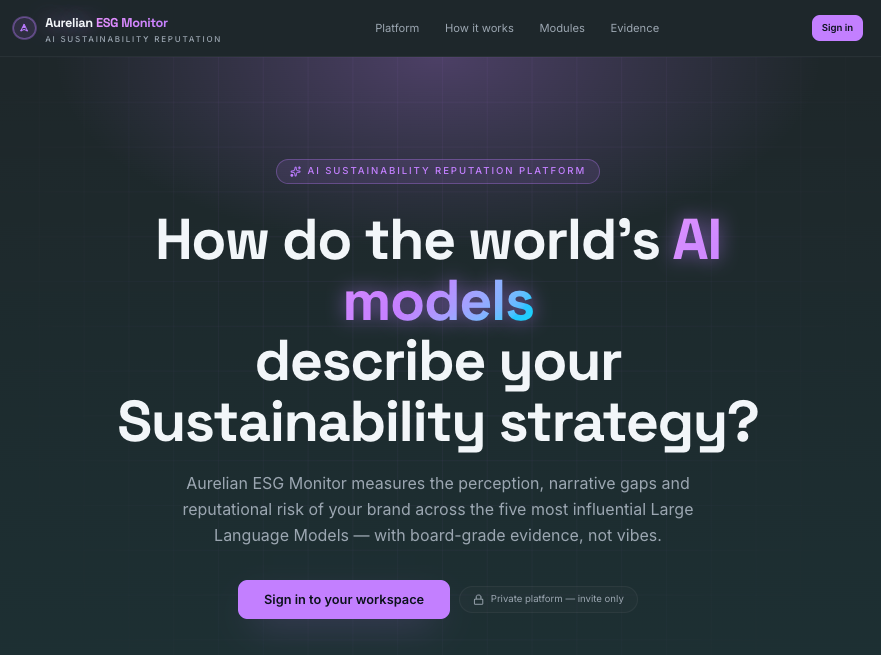
Aurelian ESG Monitor

What do AI systems say about your sustainability?

Queries the leading language models and turns their answers into a view of your sustainability reputation: what they say about you, in what tone and based on which sources.

You receive: The statements to correct and the sources to work on.

It is used to verify and correct how AI describes sustainability.

Open the tool

The tools do not replace judgement: every result is read and interpreted by a person, and becomes an action only where the data justifies it.

Regulatory transparency

The Aurelian Intelligence tools are measurement and analysis tools. They process aggregated public data under human supervision and are intended for general companies.

Read the AI Act FAQ

A concrete case. For Banca delle Visite we analysed the website with AEO Boost and StakeGraph and built an AEO+GEO roadmap, now being implemented.

FAQ

Frequently asked questions

All FAQs →

The only reliable way is to query them systematically. Asking a single AI once is not enough: each LLM has different characteristics, and answers vary by query, date and model version. A structured Corporate & AI Reputation Audit — analysing multiple systems with queries calibrated on the dimensions relevant to your organisation — is the starting point. That is exactly what the suite of proprietary tools Aurelian Intelligence does.

GEO (Generative Engine Optimization) is the discipline that optimises content to be cited and synthesised by AI systems. AEO (Answer Engine Optimization) optimises content to answer users' questions directly inside answer engines. Neither is a technical matter for the IT team: they are strategic levers of corporate communication. Without algorithmic readability, even the best reputational strategy remains invisible to the systems that increasingly mediate the first contact between your company and its stakeholders.

Through systematic and comparative analysis of multiple LLMs, queried with prompts calibrated on defined dimensions: sentiment (overall tone of the representation), visibility (frequency of citation in relevant queries), thematic coverage (which dimensions emerge and which are missing), narrative consistency (do the different systems converge or contradict each other?) and reputational risk (do negative, outdated or potentially false items emerge?). The result is a map of the distance between real identity, available evidence and algorithmic representation.

The tools serve the Aurelian Lab AI Reputation Framework. Every result is read and interpreted by Maria Luisa De Petris.

Book 30 minutes